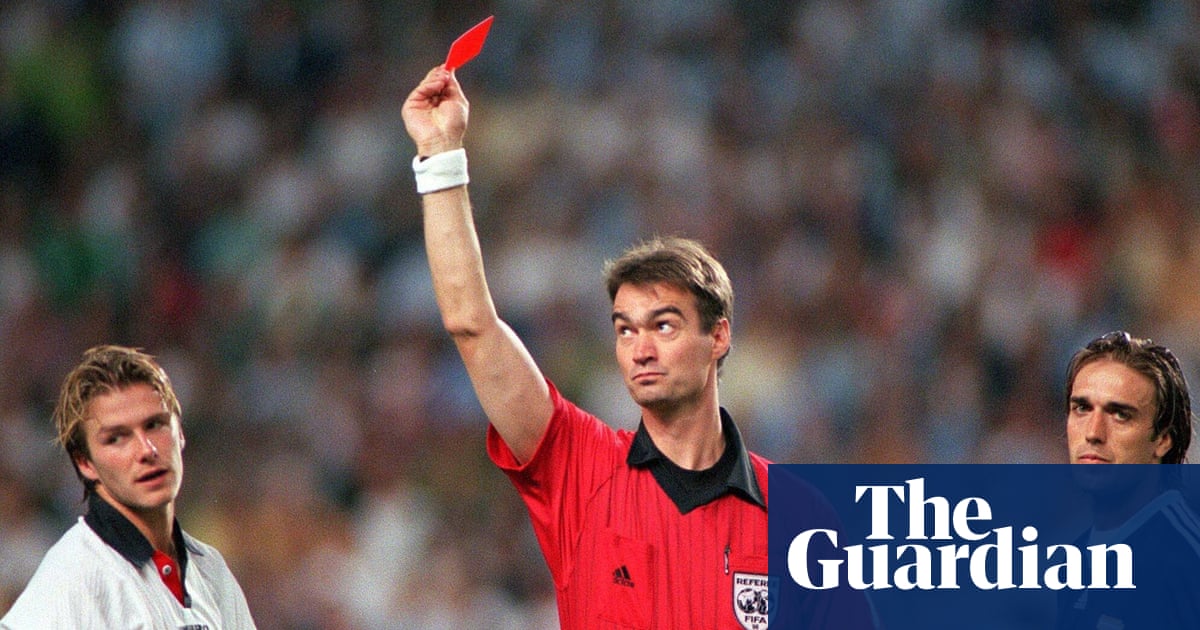
The Red Card That Changed Everything: Referee Kim Milton Nielsen Relives the Night He Sent Off Beckham
Guardian Football·September 7, 2026
When Kim Milton Nielsen pushed open the changing room door at Saint-Étienne's Geoffroy-Guichard Stadium on 30 June 1998, he allowed himself a rare moment of satisfaction. The air hung heavy with the smell of wet towels as the Danish official embraced his assistants. Together, they had just officiated the greatest half of football of their careers.
Argentina versus England. World Cup round of 16. A fixture steeped in history, and on this humid French evening, it delivered drama in relentless waves.
Michael Owen had terrorised the Argentine backline with blistering runs and announced himself to the world with a breakout goal of breathtaking audacity. A cleverly worked free-kick had outwitted the English defence, with Javier Zanetti applying the finish in first-half stoppage time. Nielsen had pointed to the penalty spot twice — decisions at both ends that kept the contest boiling. Batistuta and Shearer had both converted.
The referee could hardly wait for the second half to begin. He had no idea what was coming.
Minutes after the restart, Beckham, fouled by Diego Simeone near the halfway line, petulantly flicked his boot at the Argentine as he fell to the turf. It was a moment of madness lasting barely a second. Nielsen reached for the red card, and the trajectory of English football changed forever.
England, reduced to ten men, defended heroically. Sol Campbell thought he had won it late, only for the goal to be ruled out. The night drifted to penalties, where David Batty's miss sent Argentina through and triggered a wave of vilification aimed at a 23-year-old Beckham — death threats, burned effigies, and a national inquisition from which he would eventually emerge, spectacularly redeemed.
For Nielsen, that single act of discipline became his calling card. As he recounts in a new book, wherever his travels take him, the same words inevitably greet him: "Hey, you are the man who sent off Beckham."
More than a quarter of a century later, with the World Cup returning to global attention in 2026, the story remains a timeless reminder of how tournaments turn on the smallest margins — a flick of a boot, a flash of red, a referee's conviction in the eye of a storm. Nielsen walked into that Saint-Étienne dressing room at half-time believing he had already seen everything the game could offer. The second half was about to prove him gloriously, brutally wrong.
This article is adapted from an extract originally published by Guardian Football.
🔥 Discover More World Cup Content
Sponsored
Related News
Captain Bowen's Brace Ends 31-Year Wait as West Ham Seize Championship Summit
Guardian Football · Sep 9
Mbappé and Valverde Fire Real Madrid Past Inter Milan in Timely World Cup 2026 Form Boost
Sky Sports · Sep 9
Record-Breaking Summer: MLS Clubs Splurge Nearly $190M as World Cup 2026 Looms
Guardian Football · Sep 9